Academy and scouts: find and develop tomorrow’s talent
Twelve places, dozens of profiles: you decide who deserves to be developed.
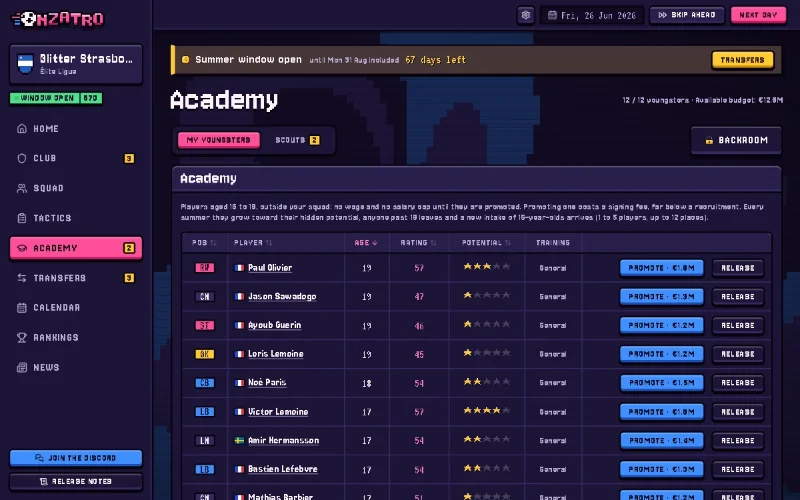
Your academy is a cheap way to build a squad, and it is also a long game. This guide covers the academy in Simulation mode; in Arcade it runs itself, see the mode guide.
How the academy works
Your club has an academy of up to twelve young players aged 16 to 19. Every summer a new group of 16-year-olds arrives, bigger clubs taking more of them. Academy players are not part of your squad, do not count in the wage bill and do not play matches until you sign them.
Reading a young player
Each young player has a rating and a potential, shown as one to five stars. Five stars is a future starter in the top division. The stars are a scout's estimate: the younger the player, the less sure it is, and it gets sharper every year. We never show the real potential.
Signing and releasing
Signing a young player gives him his first professional contract: you pay a signing fee, and he joins the squad with a rookie wage. The squad holds at most 26 players, so make room first. Any player older than 19 must be signed or released before the new season starts.
Training a young player
Each young player can follow a training theme (physical, attacking, defending, technical, mental or goalkeeping), and learn a second role. Playing time matters most: young players with minutes progress faster than those left on the bench. Having veterans in the squad also helps: an experienced player who has been at the club for years can mentor a young player trained there.
Scouts: finding talent outside
You have two scouts. Give each a mission: pick a zone on the pixel globe among the ten available, then narrow it down with filters on position, age from 15 to 18, minimum stars and maximum fee. Every Monday a scout may bring you a proposal, up to three waiting at once, and a proposal expires after two weeks.
Following a young player
Following a proposal keeps it from expiring and builds the scouting report week after week. Attributes appear as ranges that narrow down, and the character is revealed once the report is complete enough. The cost is a place among your scout's three: you have to choose who is worth watching.
Recruiting
Recruit a young player at any time of the year for a small fee, shown on the proposal. If your academy is full, release someone or promote a player first: with a dozen places and many proposals, choosing is part of the game.
Staff matters
The stars of your scouts decide how often they find someone and how quickly their reports fill up. You can hire a new scout in the Staff tab. Your coaches also change how fast young players improve.
Where to go next
Young players are also useful in the squad: see the tactics guide to give them a role, and the transfer guide to sell those you cannot use.
Free, no account: the game starts in your browser.
Play nowKeep reading
- Beginner guide First steps in a football management game: pick a club, set up the game, read the board’s targets, run your transfers and play your first match. Read the guide
- Simulation or Arcade Two modes for the same football world: full club management, or arcade with a market of player packs. What changes, and who each one suits. Read the guide
- Tactics Formations, roles, game plan, set pieces and live changes: how tactics shape the result of a match in Onzatro. Read the guide
- Transfers Transfer windows, offers, counter-offers, contracts, loans and the wage budget: what to know to run a successful transfer market. Read the guide
- Football Manager alternative A free football management game with no account and nothing to install: what Onzatro shares with a manager game, what is different, and who it suits. Read the guide