Transfers: buy, sell and negotiate
A club is built in two windows a year: here is how they work.
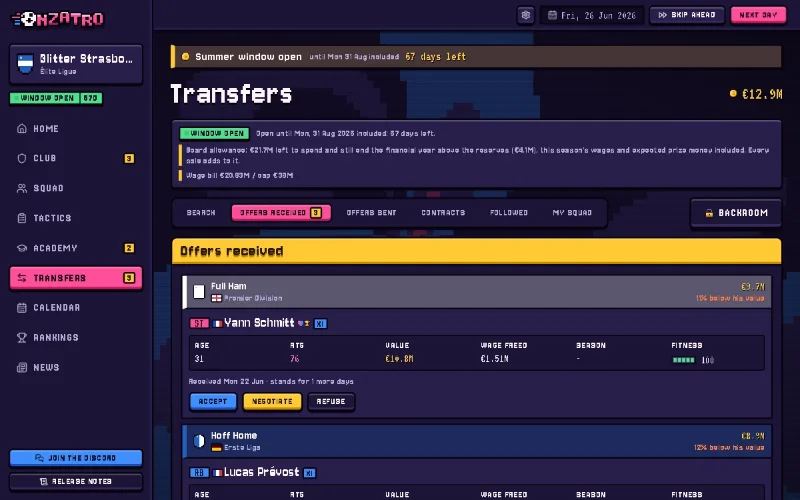
Transfers are how you shape your squad. This guide covers the market in Simulation mode; Arcade works with packs, explained in the mode guide.
Two windows a year
The summer window opens on June 1 and closes on August 31, so it runs through the first matchdays. The winter window lasts all of January. You can negotiate all year long: a deal agreed while the window is closed is carried out on the first day of the next one.
Finding players
The market search lists every player in the world, with filters for position, role, age, nationality, country, division, price, rating and free agents. Press the star to follow a player. Your recruiters also send proposals, and followed players get a scouting report: attributes stay blurred until you know the player, then the report sharpens week after week.
Making an offer
Every player has a market price, shown in the search and on his sheet. His club asks more or less depending on whether it wants to sell him or is attached to him: the sheet says which way it leans, never by how much. You offer an amount and the club answers the next day:
- if your offer is enough, it accepts, and you confirm the deal;
- otherwise it names a price, higher than the one it would have accepted: aiming well pays;
- an offer that is too low is refused.
A player’s price follows the player, not his place at his club: his level, his age, his contract (cheaper with one or two years left), his last season, and above all demand. The more clubs would start him, the more he costs, even if he sits on the bench where he is. The club then adjusts: a club chasing the title asks more, a selling club or a player put up for sale costs less. A club never sells if it would be left without enough players at that position.
A price named binds the club for the season: it will not go up, but it will not come down either, even if your next offer beats what it would have accepted at first. After three offers without a deal, the club stops talking and only sells at its price.
Negotiating the contract
Once the club agrees, you negotiate with the player: wage, length from one to five years and the role you promise him, from key player to prospect. He answers at once. After three refusals he walks away for the season. An unhappy player asks for more. Keep your promises: a starter who sits on the bench becomes unhappy and may ask to leave.
Selling and renewing
List a player to attract offers, or wait for clubs to bid on their own. You can accept, refuse or make one counter-offer. A player who just changed clubs cannot receive offers for a year. Releasing a player costs you part of his remaining wages. If you sell at a profit a player bought less than two seasons ago, his former club takes 20% of it.
Loans
You can take a player on loan from a club, or lend yours. A loan costs far less than a transfer and the borrower pays his full wage. If the contract runs long enough, the loan comes with an option to buy.
Money and the wage budget
Your budget is what you can spend on fees. Your wage budget caps the total of your wages: you may go over it, but a fine arrives at the end of the summer window. If a signing does not fit, you have tools:
- pay a fee in up to three instalments;
- convert part of your wage budget into cash over three seasons, or the other way round;
- sell a player first.
Free agents
Players without a club can be signed in any open window, with a signing fee of about one year of wages. A player in his last contract year can also be renewed at any time of the season.
A last tip
Do not sign by rating alone. Check age, contract length, mood and the place he fills in your squad, then read the tactics guide to make sure he fits your plan.
Free, no account: the game starts in your browser.
Play nowKeep reading
- Beginner guide First steps in a football management game: pick a club, set up the game, read the board’s targets, run your transfers and play your first match. Read the guide
- Simulation or Arcade Two modes for the same football world: full club management, or arcade with a market of player packs. What changes, and who each one suits. Read the guide
- Tactics Formations, roles, game plan, set pieces and live changes: how tactics shape the result of a match in Onzatro. Read the guide
- Academy and scouts Recruit youngsters with your scouts, follow their report, train them and choose who signs a pro deal: the guide to your club’s academy. Read the guide
- Football Manager alternative A free football management game with no account and nothing to install: what Onzatro shares with a manager game, what is different, and who it suits. Read the guide